
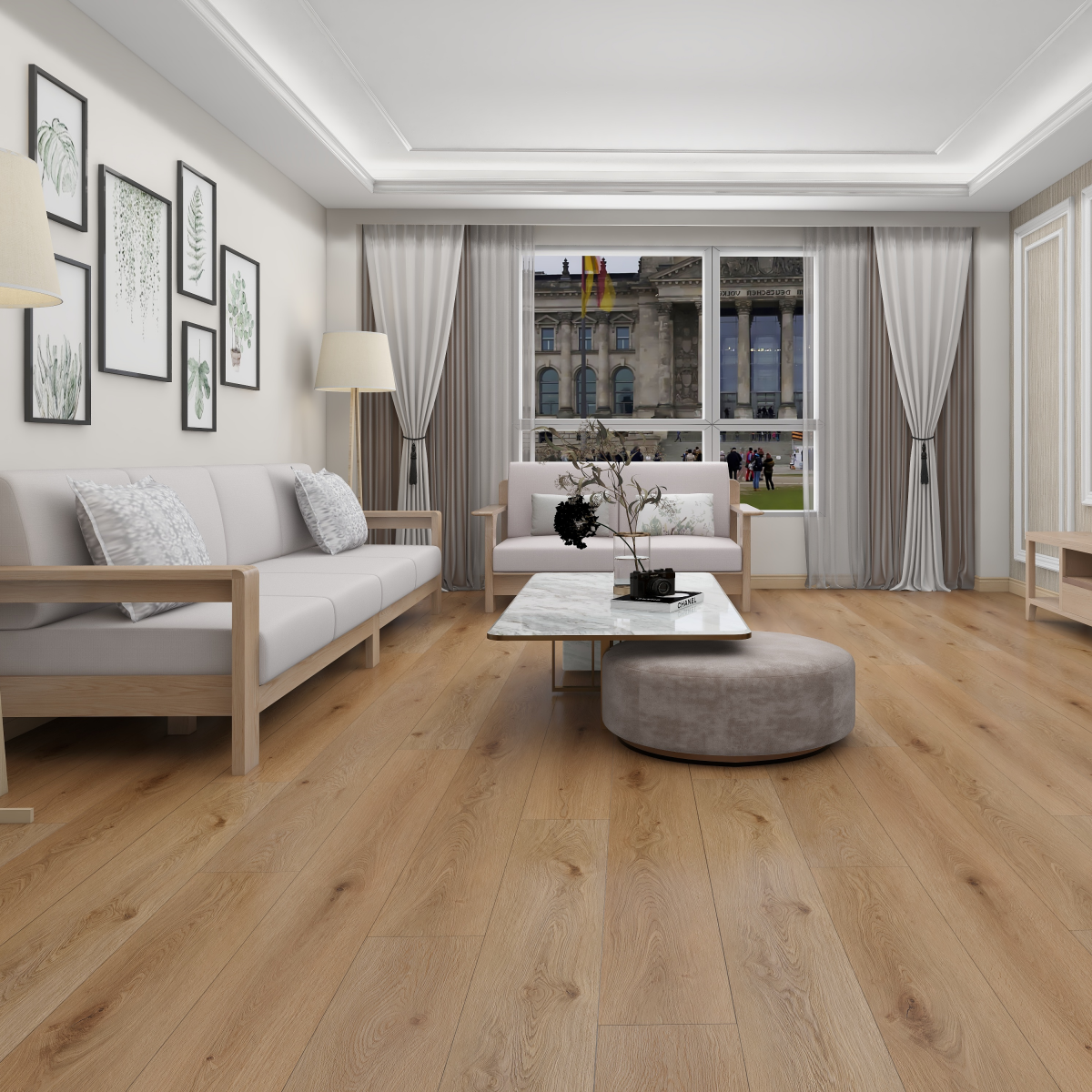
What is SPC Flooring? Complete Buyer's Guide for 2026
SPC flooring has become a popular choice for residential and commercial applications because of its rigid construction, dimensional stability, water resistance, and relatively simple installation. But choosing the right SPC flooring requires more than comparing colors and prices. Understanding the flooring's core construction, wear layer, thickness, locking system, installation requirements, and intended application can make a significant difference in long-term performance.
In this complete SPC flooring buyer's guide, we'll explain what SPC flooring is, how its multi-layer construction works, what to look for in wear layer thickness and overall product specifications, and how SPC compares with other vinyl flooring options such as LVT and WPC. We'll also cover installation requirements, cost considerations, and the key factors to consider when selecting SPC flooring for residential, commercial, and large-scale projects.
With more than 20 years of experience in PVC flooring manufacturing, Hanflor provides this guide to help contractors, distributors, importers, and property owners make informed decisions when selecting and sourcing SPC flooring.
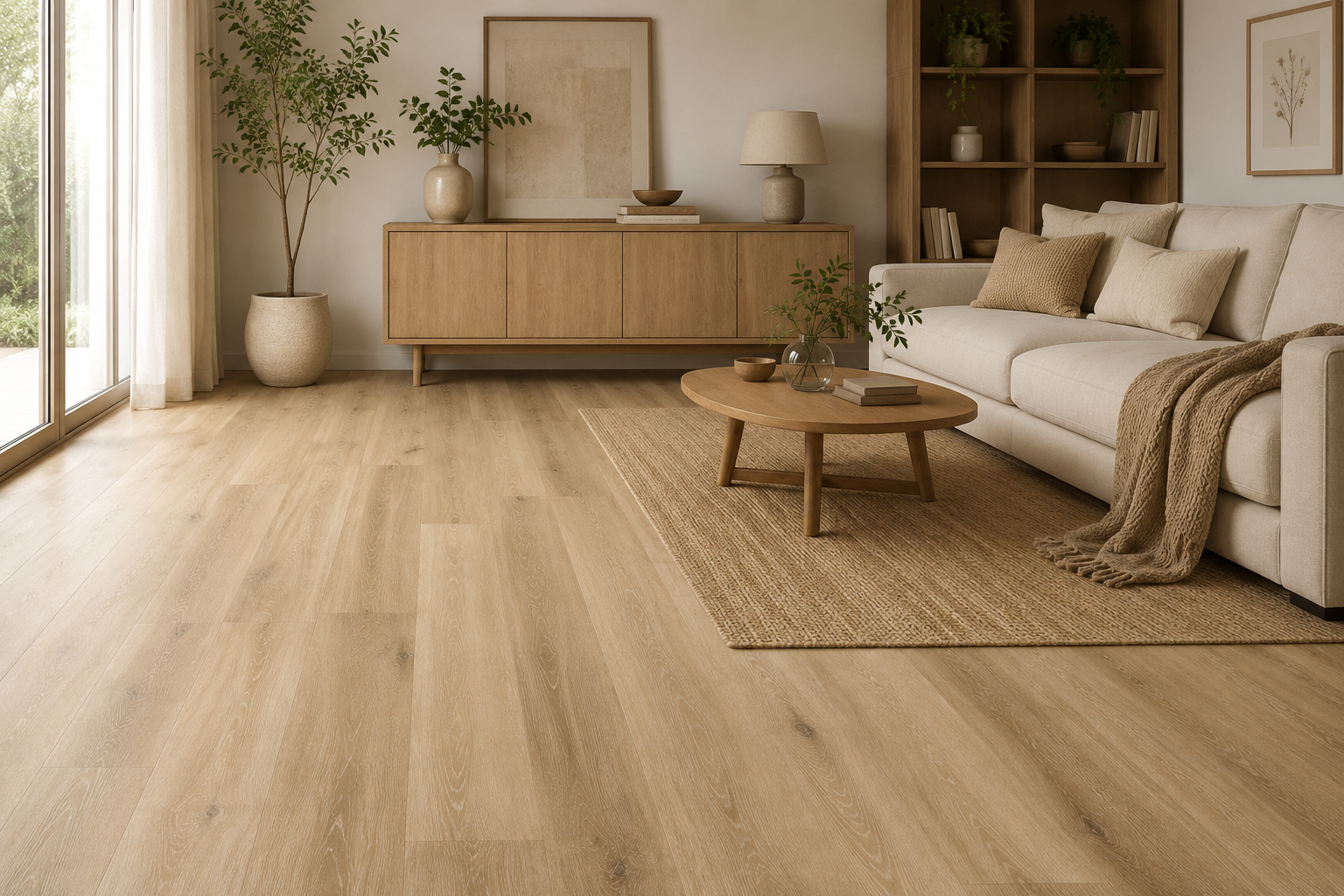
What Is SPC Flooring? Understanding the Basics
SPC stands for Stone Plastic Composite, although it is also commonly referred to as Stone Polymer Composite. It is a type of rigid core luxury vinyl flooring made with a core that typically combines natural limestone powder (calcium carbonate), polyvinyl chloride (PVC) resin, and stabilizers. This rigid core gives SPC flooring high dimensional stability, good dent resistance, and low sensitivity to moisture compared with traditional flexible vinyl flooring.
Unlike conventional flexible vinyl flooring, SPC has a rigid core that provides greater structural stability underfoot. Many SPC products feature a click-lock system and are installed as floating floors without adhesive. Depending on the product design and installation requirements, SPC can be installed over suitable existing hard surface floors, provided the substrate is flat, dry, clean, stable, and properly prepared. SPC flooring is commonly available in plank formats designed to replicate hardwood as well as tile and stone-inspired designs.
Key Fact: The rigid SPC core is one of the main reasons the product has become widely used in residential and commercial flooring applications. Compared with flexible vinyl, SPC generally offers greater rigidity and resistance to indentation, while its waterproof construction and click installation make it a practical option for a wide range of projects. However, actual performance depends on the core formulation, overall thickness, wear layer, locking system, and installation conditions.
How SPC Flooring Is Constructed: The Multi-Layer Structure
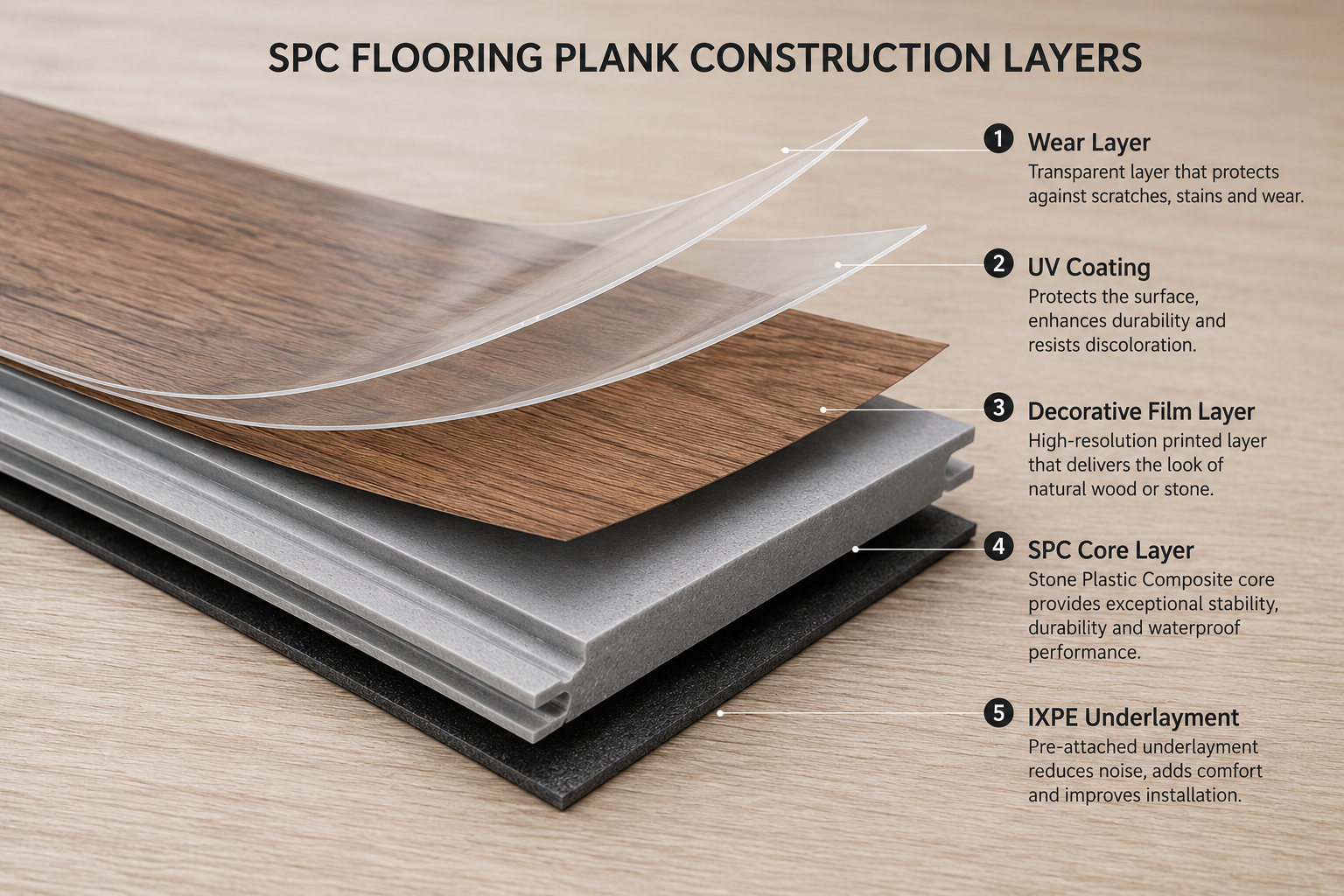
Most SPC flooring products feature a multi-layer construction, with each layer serving a specific function that contributes to the overall performance, durability, and appearance of the floor. Understanding these layers helps buyers evaluate product quality and select the right SPC flooring for different applications.
1. UV Coating (Top Layer)
A thin UV-cured coating applied to the surface of the plank that improves scratch resistance, stain resistance, and protection against surface fading caused by light exposure. This protective layer helps maintain the appearance of the floor over time.
2. Wear Layer
A transparent protective PVC layer, commonly available in options such as 12 mil (0.3mm), 20 mil (0.5mm), and higher specifications for demanding applications. The wear layer is one of the key factors used to evaluate surface durability, scratch resistance, and suitability for residential, commercial, or high-traffic environments.
3. Design Layer
A high-resolution printed film that creates the visual appearance of natural materials, including hardwood, marble, and stone. Advanced printing technologies and embossed-in-register (EIR) textures provide more realistic surface details and improved visual depth.
4. SPC Rigid Core
The structural foundation of the plank, typically made from a combination of limestone powder (calcium carbonate), PVC resin, and stabilizers. This rigid core provides dimensional stability, impact resistance, and the structural strength required for click-lock flooring systems.
5. Attached Underlayment (Optional)
Many SPC products include a pre-attached IXPE / EVA or cork backing, usually ranging from 1mm to 2mm in thickness. The attached underlayment improves sound absorption, walking comfort, and installation convenience. However, proper subfloor preparation and moisture testing are still required to ensure long-term flooring performance.
SPC Core Composition: What Makes It So Rigid?
The SPC core is one of the key features that differentiates SPC flooring from traditional flexible vinyl products. This rigid core is made from a carefully balanced blend of natural limestone powder (calcium carbonate), PVC resin, and stabilizers, creating a dense structure with excellent dimensional stability, indentation resistance, and temperature performance.
Depending on the manufacturer's formulation, SPC cores typically contain a high percentage of limestone powder combined with PVC and other additives. A common formulation may include approximately 60–80% limestone content, although the exact ratio varies based on product design and performance requirements. A balanced formulation is essential — while higher mineral content can increase rigidity and density, excessive filler may affect impact resistance and locking performance.
The higher density of SPC is one reason why SPC planks are generally heavier than comparable WPC or flexible LVT products. This dense rigid core helps reduce the risk of indentation caused by furniture loads, dropped objects, and daily foot traffic.
| Core Type | Main Material | Flexibility | Dent Resistance | Stability |
|---|---|---|---|---|
| SPC | Limestone + PVC | Rigid | High | Excellent |
| WPC | Wood/plastic composite | Semi-rigid | Medium | Good |
| LVT | Flexible PVC | Flexible | Lower | Moderate |
Density Comparison: SPC flooring typically has a core density significantly higher than WPC and traditional flexible LVT. This increased density contributes to improved dimensional stability and resistance to indentation, making SPC a preferred option for residential, commercial, and high-traffic applications.
Wear Layer Thickness Guide: Choosing the Right Protection
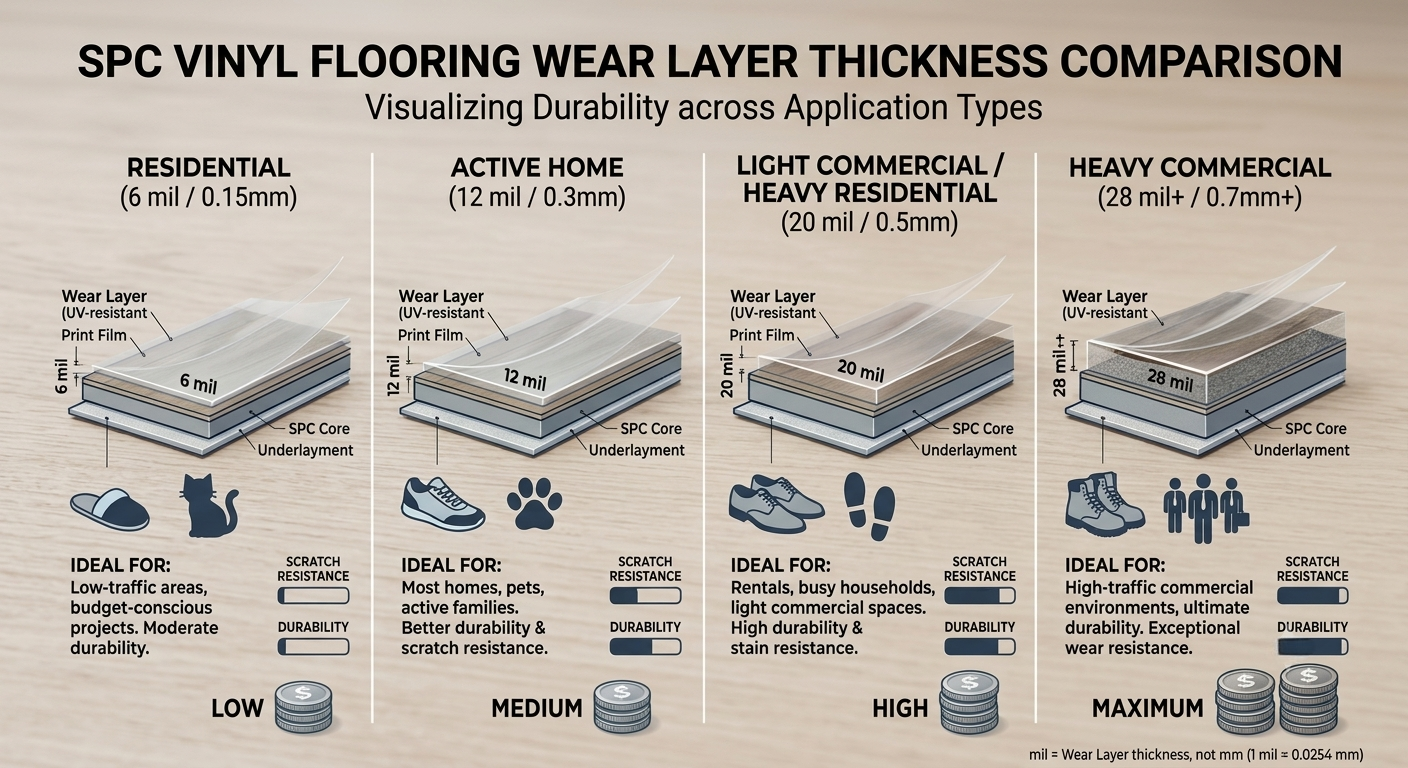
The wear layer is one of the most important factors affecting SPC flooring durability. This transparent protective layer helps the floor resist scratches, scuffs, stains, and daily wear. The right wear layer thickness should be selected based on the intended application, traffic level, and performance expectations.
| Wear Layer | Durability Rating | Best Application | Expected Lifespan |
|---|---|---|---|
| 6-8 mil (0.15- 0.2 mm) | Light residential | Bedrooms, guest rooms, closets | 10+ years |
| 12 mil (0.3mm) | Standard residential | Living rooms, hallways, dining areas | 15+ years |
| 20 mil (0.5mm) | Premium residential / Light commercial | Kitchens, entryways, offices, rental properties | 20+ years |
| 22-28 mil (0.55- 0.7 mm) | Commercial grade | Retail stores, restaurants, high-traffic commercial, school, hospitality | 20+ years depending on conditions |
*Actual service life depends on installation quality, maintenance, traffic conditions, and environmental factors.
For many residential projects, a 12 mil (0.3mm) wear layer provides reliable everyday performance, while 20 mil (0.5mm) is often selected for premium residential and light commercial applications where higher durability is required. For commercial projects, higher wear layer specifications may be recommended based on traffic intensity and usage requirements.
When sourcing SPC flooring, manufacturers can customize specifications such as wear layer thickness, overall plank thickness, surface texture, and backing options to match different markets and project needs.
SPC vs WPC Flooring: Key Differences
SPC and WPC (Wood Plastic Composite) are both rigid-core luxury vinyl products, but their core composition creates meaningful differences in performance. Here is a comprehensive comparison:
| Feature | SPC Flooring | WPC Flooring |
|---|---|---|
| Core composition | Limestone + PVC | Wood dust + PVC |
| Core density | Very high (heavier) | Moderate (lighter) |
| Comfort underfoot | Firm | Softer, more cushioned |
| Dent resistance | Excellent | Good |
| Temperature stability | Excellent | Good |
| Sound absorption | Moderate | Better |
| Typically Thickness | 4.0-8 mm | 8 mm |
| Cost per sq ft | $0.54 - $0.69 | $0.97 |
| Best for | High traffic, commercial, basements | Bedrooms, living rooms, comfort priority |
Bottom line: Choose SPC for durability, dent resistance, and high-traffic areas. Choose WPC for comfort, sound absorption, and living spaces where you spend long periods standing or walking barefoot.
SPC vs Laminate Flooring: Which Is Better?
Laminate flooring has been a popular flooring option for decades due to its affordable price, realistic wood appearance, and wide range of design choices. However, SPC flooring provides specific performance advantages, especially in areas where moisture resistance and dimensional stability are important.
The fundamental difference between SPC and laminate flooring lies in their core construction. Laminate flooring uses an HDF (high-density fiberboard) core made from compressed wood fibers and resin, while SPC flooring uses a rigid Stone Plastic Composite core made from limestone powder, PVC resin, and stabilizers. This difference in core materials gives SPC greater resistance to moisture, improved dimensional stability, and better performance in environments where traditional laminate may be more vulnerable.
| Feature | SPC Flooring | Laminate Flooring |
|---|---|---|
| Core Material | Limestone + PVC composite | HDF wood fiber |
| Water resistance | 100% waterproof | Limited moisture resistance |
| Dimensional Stability | Excellent | More affected by humidity |
| Durability | High dent and scratch resistance | Good scratch, less dent resistance |
| Installation | Click, often with attached underlayment | Click, requires separate underlayment |
| Underfloor heating | Compatible | Limited compatibility |
| Comfort Underfoot | More rigid | Slightly warmer / softer feel |
| Best Applications | Kitchens, bathrooms, basements, commercial spaces etc | Dry residential areas |
For kitchens, bathrooms, basements, and laundry rooms, SPC is the clear winner due to its waterproof construction. Laminate still has a place in dry living spaces where budget is the primary concern, but the gap in price has narrowed significantly as SPC production has scaled.
SPC vs LVT: Rigid Core vs Flexible Vinyl
While both SPC and LVT (Luxury Vinyl Tile) belong to the vinyl flooring category, their core constructions create different performance characteristics and application advantages. The main difference lies in the core structure: SPC uses a Rigid Stone Plastic Composite core, while traditional LVT uses a flexible PVC-based core.
This difference affects factors such as dimensional stability, underfoot feel, installation method, and suitability for different environments. Understanding the advantages and limitations of both SPC and LVT helps contractors, distributors, and property owners select the right flooring solution based on project requirements, installation conditions, and expected performance.
| Feature | SPC Flooring | LVT Flooring |
|---|---|---|
| Core composition | Stone Plastic Composite (rigid) | Flexible PVC (soft) |
| Structure | More rigid, denser feel | More flexible, softer feel |
| Installation | Usually click | Dryback/click |
| Subfloor tolerance | Requires flat subfloor | More forgiving |
| Dimensional stability | High stability, minimal expansion | Moderate, more susceptible to temperature |
| Dent resistance | Higher resistance | Lower resistance |
| Best applications | Residential, commercial, high-temperature variation areas. | Commercial, renovation, areas requiring flexibility |
Top Advantages of SPC Flooring
SPC flooring has become a popular choice for residential and commercial applications due to its durability, water resistance, dimensional stability, and easy maintenance. Here are the key benefits that make SPC flooring a preferred option for many projects:
Exceptional Durability
SPC flooring features a rigid stone composite core that provides excellent resistance to indentation, daily wear, and heavy foot traffic. With proper installation and maintenance, SPC flooring can deliver reliable long-term performance in both residential and commercial applications.
100% Waterproof
Unlike wood-based flooring products such as hardwood and laminate, SPC has a waterproof rigid core that helps prevent swelling and structural damage caused by moisture exposure. This makes it suitable for kitchens, bathrooms, basements, and other moisture-prone areas.
Realistic Wood and Stone Designs
Advanced HD printing and EIR texturing make SPC planks virtually indistinguishable from natural wood or stone. Available in wide planks, chevron, herringbone, and countless colors.
Dimensional Stability
The rigid SPC core provides excellent dimensional stability and helps reduce the impact of temperature and humidity changes. This makes SPC a reliable choice for areas exposed to seasonal climate variations.
Easy Installation
No glue or complicated tools required. Most homeowners can complete a standard room in 4-6 hours with basic DIY skills, significantly cutting labor costs.
Easy Maintenance
The non-porous surface prevents stains from coffee, wine, and mud. Daily maintenance requires only regular sweeping and occasional damp mopping with a pH-neutral cleaner.
Potential Drawbacks of SPC Flooring to Consider
While SPC flooring is an excellent choice for many applications, it also has some limitations. Understanding these considerations helps buyers select the right flooring solution for their specific needs.
- Firmer underfoot than WPC: Because of its rigid mineral core, SPC provides excellent stability and indentation resistance but generally feels firmer underfoot compared with WPC or softer flooring options. An attached underlayment can improve sound performance and walking comfort.
- Requires proper subfloor preparation: The rigid construction of SPC means it is less forgiving of uneven substrates. Surface imperfections may affect the finished appearance, create hollow sounds, or place stress on the click system over time. Proper subfloor preparation is essential.
- Cannot be refinished: Unlike hardwood flooring, SPC cannot be sanded and refinished. If the wear layer or surface is significantly damaged, replacement of the affected planks or flooring may be required.
- Heavier than flexible flooring products: Due to its dense limestone-based core, SPC is generally heavier than flexible LVT and some WPC products. This may require additional consideration during transportation, handling, and installation.
- Quality varies between products: The appearance and performance of SPC can vary depending on core formulation, wear layer thickness, surface texture, and manufacturing quality. Selecting the right specification is important for achieving the expected result.
- Consider indoor air quality standards: Buyers should evaluate flooring products based on relevant testing and certifications, such as FloorScore or other indoor air quality standards, to ensure compliance with project requirements.
Best Rooms for SPC Flooring
One of the greatest advantages of SPC is its versatility — it can be installed in virtually any room. However, some rooms benefit more from SPC's specific properties than others:
| Room | Rating | Why SPC Works Here |
|---|---|---|
| Kitchen | Excellent | Waterproof core handles daily spills, stains, and heavy use. Easy to clean and maintain. |
| Bathroom | Excellent | Moisture-resistant and suitable for wet areas with proper installation and sealing. |
| Basement | Excellent | Performs well over properly prepared concrete subfloors with good moisture resistance. |
| Laundry Room | Excellent | Handles daily moisture exposure and helps prevent swelling or damage. |
| Living Room | Very Good | Durable for everyday traffic with realistic wood and stone designs. |
| Bedroom | Good | Suitable for bedrooms, although softer flooring may provide a warmer feel. |
| Sunroom | Excellent | Good dimensional stability in areas with temperature changes. |
| Entryway/Mudroom | Excellent | Wear-resistant surface handles dirt, moisture, and daily foot traffic. |
SPC Flooring Installation: A Complete DIY Guide
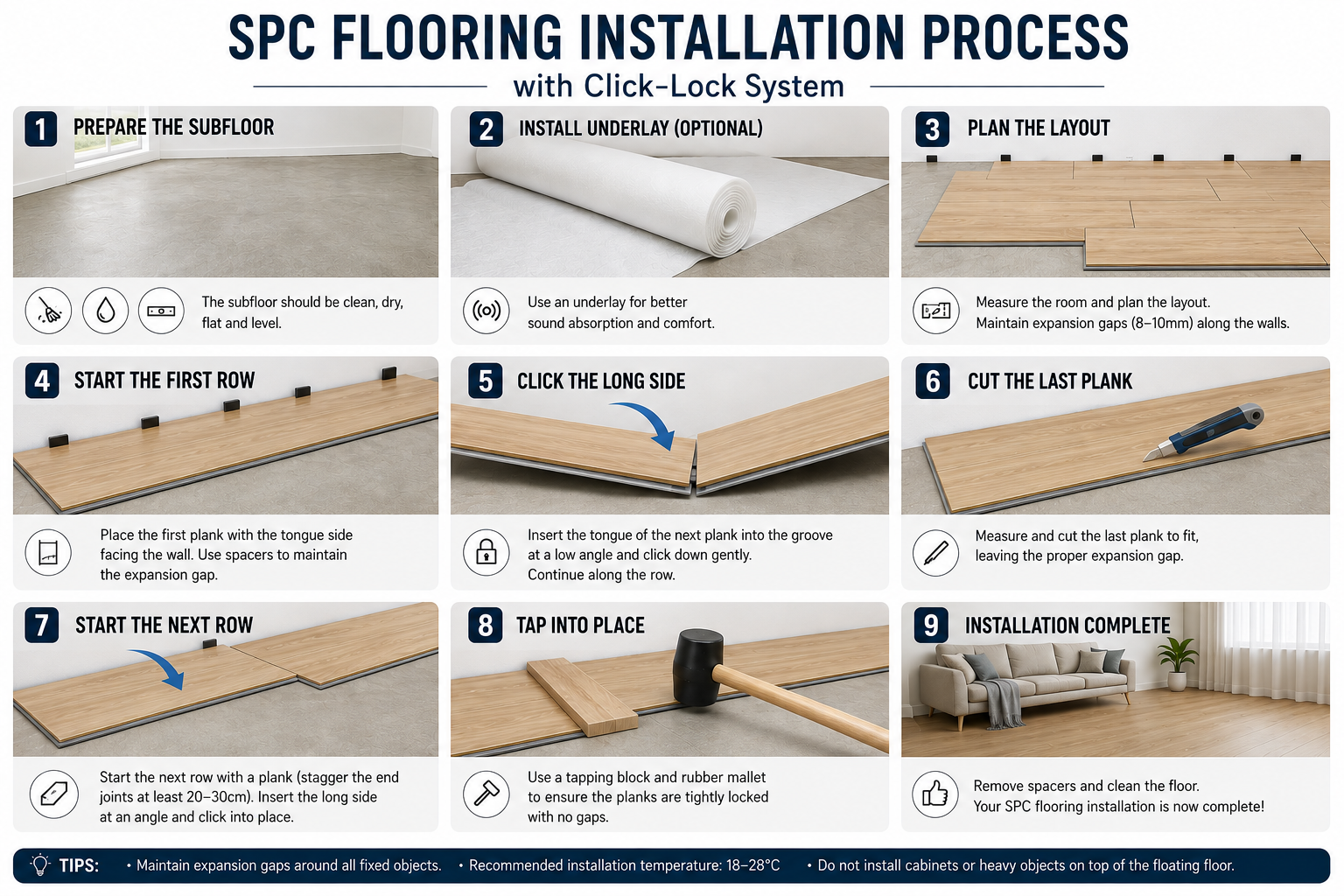
SPC flooring uses a click floating installation that is among the easiest flooring installations for DIYers. Here is a step-by-step guide to achieving a professional result:
Step 1: Prepare the Subfloor
Ensure the subfloor is clean, dry, and flat. SPC requires subfloor flatness within 3/16 inch over a 10-foot span. Fill low spots with self-leveling compound and sand down high spots. Remove all debris, dust, and adhesive residue. SPC can be installed over concrete, plywood, existing vinyl, and tile — but never over carpet.
Step 2: Acclimate the Planks
Place unopened boxes in the installation room for 24-48 hours. Maintain room temperature between 65-85°F (18-29°C). While SPC is less sensitive to temperature than hardwood, acclimation ensures optimal results and prevents post-installation gaps.
Step 3: Plan Your Layout
Install planks parallel to the main light source (window) for a seamless look. Measure room width to ensure the last row will be at least 2 inches wide. Stagger end joints by at least 6-12 inches between rows. Mix planks from multiple boxes to ensure natural color variation.
Step 4: Install the First Row
Start in the top-left corner with the tongue side facing the wall. Insert 1/4-inch spacers along the wall to maintain the expansion gap. Connect planks by angling the short end at approximately 30 degrees into the previous plank's groove, then press down flat until you hear a click.
Step 5: Continue Row by Row
Begin the second row with a cut-off piece from the first row (at least 12 inches long) to maintain stagger. Angle the long side into the previous row's groove and press down to lock. Use a rubber mallet and tapping block to ensure tight seams. Check alignment every 3-4 rows.
Step 6: Handle Obstacles
For door frames, undercut the frame so planks slide underneath. For pipes, drill a hole 1/4 inch larger than the pipe diameter and cut a slit from the edge. For irregular corners, create a cardboard template and cut with a jigsaw.
Step 7: Finishing Touches
Remove all spacers. Install baseboards by nailing into the wall (never the floor). Install transition strips at doorways. Avoid heavy furniture placement for at least 24 hours.
How Much Does SPC Flooring Cost in 2026?
The cost of SPC flooring varies depending on thickness, wear layer, core formulation, surface texture, backing, and order quantity. Compared with traditional flooring options, SPC provides a good balance between durability, performance, and overall value.
Typical factors affecting SPC flooring cost include:
- Thickness: Thicker SPC planks generally require more raw materials and provide enhanced stability.
- Wear Layer: 12 mil (0.3mm) is common for residential applications, while 20 mil (0.5mm) and above are often selected for premium residential and commercial projects.
- Surface Technology: EIR textures, special embossing, and customized designs can increase product cost.
- Order Quantity: Bulk purchases and container orders usually offer more competitive pricing compared with small quantities.
For distributors, contractors, and project buyers, selecting the right SPC specification based on the application is often more important than choosing the lowest price. Hanflor provides customized SPC flooring solutions with different thicknesses, wear layers, and designs to meet various market requirements.
How to Maintain SPC Flooring
SPC flooring is one of the easiest hard flooring options to maintain. With proper installation, cleaning, and care, quality SPC flooring can provide reliable long-term performance.
Cleaning Guidelines
- Sweep or vacuum regularly to remove dirt and grit that may scratch the surface.
- Use a damp microfiber mop with a pH-neutral vinyl floor cleaner.
- Clean spills promptly to keep the flooring surface in good condition.
What to Avoid
- Avoid steam mops, harsh chemicals, abrasive cleaners, and wax products, as they may damage the protective surface layer.
- Do not use excessive water during cleaning.
- Avoid dragging heavy furniture directly across the floor.
Preventive Care
- Use felt pads under furniture legs to reduce scratches.
- Place mats at entrances to minimize dirt and debris.
- Use window coverings in areas with prolonged direct sunlight to help protect the floor appearance.
Frequently Asked Questions About SPC Flooring
What does SPC stand for in flooring?
SPC stands for Stone Plastic Composite (also called Stone Polymer Composite). It refers to the rigid core made from limestone powder, PVC resin, and stabilizers.
Is SPC flooring waterproof?
Yes. SPC flooring is 100% waterproof. The stone-plastic core does not absorb moisture, making it suitable for kitchens, bathrooms, basements, and laundry rooms. However, prompt spill cleanup is still recommended to prevent water from seeping into seams.
How long does SPC flooring last?
With a 20-mil wear layer and proper maintenance, SPC flooring lasts 20-25 years in residential settings. Budget products with 6-12 mil wear layers last 10-15 years. Commercial-grade products with 28+ mil can last 25+ years.
Can SPC flooring be used with underfloor heating?
Yes. SPC is compatible with underfloor heating systems. The rigid core provides excellent thermal conductivity and dimensional stability. Surface temperature should not exceed 27°C (80°F) to protect the wear layer.
Can you install SPC flooring over existing tile?
Yes, as long as the tile surface is flat, clean, and firmly attached. SPC can be installed over most existing hard surfaces including tile, hardwood, vinyl, and concrete. Never install over carpet.
Is SPC flooring good for pets?
Yes. SPC is an excellent choice for pet owners. The waterproof core handles accidents, the dense surface resists claw scratches (especially with 20+ mil wear layers), and cleanup is simple. Trim pet nails regularly for best results.
Final Thoughts: Is SPC Flooring Right for You?
SPC flooring has earned its position as one of the most versatile and practical flooring options available in 2026. Its unique combination of 100% waterproof construction, exceptional dent resistance, dimensional stability, DIY-friendly installation, and realistic wood and stone visuals makes it an outstanding choice for kitchens, bathrooms, basements, high-traffic areas, and pet households.
For homeowners who prioritize underfoot comfort over maximum durability, WPC may be a better fit for bedrooms and living rooms. For those who need a floor that can handle anything life throws at it — spills, pets, kids, heavy furniture, and temperature swings — SPC is the clear winner.
When selecting SPC flooring, consider the wear layer, overall thickness, core quality, locking system, surface technology, and required certifications based on your application and target market.
For distributors, contractors, and project buyers, Hanflor offers SPC flooring in different thicknesses, wear layers, designs, and specifications to meet different market and project requirements.
Ready to explore SPC flooring options for your next project? Browse our SPC flooring collection or contact our team for personalized recommendations and factory-direct pricing.